AI service management is rapidly becoming a core capability for modern organizations that want to deliver faster, smarter, and more consistent service experiences. By combining traditional service management practices with AI in call centers and intelligent automation, you can turn your service desk into a proactive, always-on, and highly personalized support engine. Solutions like Boosting Efficiency with Virtual Agent Assist demonstrate how AI can streamline workflows, reduce response times, and empower service teams to focus on higher-value tasks.
This guide walks through what AI service management is, how it works, and how you can use it to boost satisfaction, reduce costs, and elevate the role of your service teams.
Implementing AI service management effectively requires strategic planning and the right technology stack. Companies looking for advanced cloud computing solutions for business often discover ways to automate routine processes while maintaining high service reliability. Similarly, exploring supercomputing platforms for enterprise AI can help process vast datasets quickly, giving service managers actionable insights and improving decision-making accuracy.
Digital marketing also complements AI service management. Organizations focusing on customer-focused marketing strategies for growth can align their AI initiatives with business objectives, creating a seamless customer experience. Leveraging innovative approaches to digital marketing campaigns ensures that AI-driven services are clearly communicated to clients, improving adoption and satisfaction.
Financial intelligence is another key aspect. Using comprehensive financial tools for service teams enables managers to track ROI, optimize budgets, and plan for future investments in AI technology. When teams combine financial insights with AI service tools, they can make informed, strategic decisions that benefit both operations and customers.
By integrating these practices and tools, AI service management transforms customer service from reactive support to proactive engagement. Businesses can anticipate client needs, reduce response times, and deliver consistent experiences, creating a smarter, more efficient, and professional service ecosystem.
Top 10 AI Service Management and Contact Center Solutions
AI service management is transforming how organizations handle customer interactions, streamline workflows, and improve efficiency in contact centers. Here’s a curated list of the top AI-driven solutions, with Bright Pattern leading the way, followed by nine competitors in the space.
1. Bright Pattern: AI Contact Center Solutions
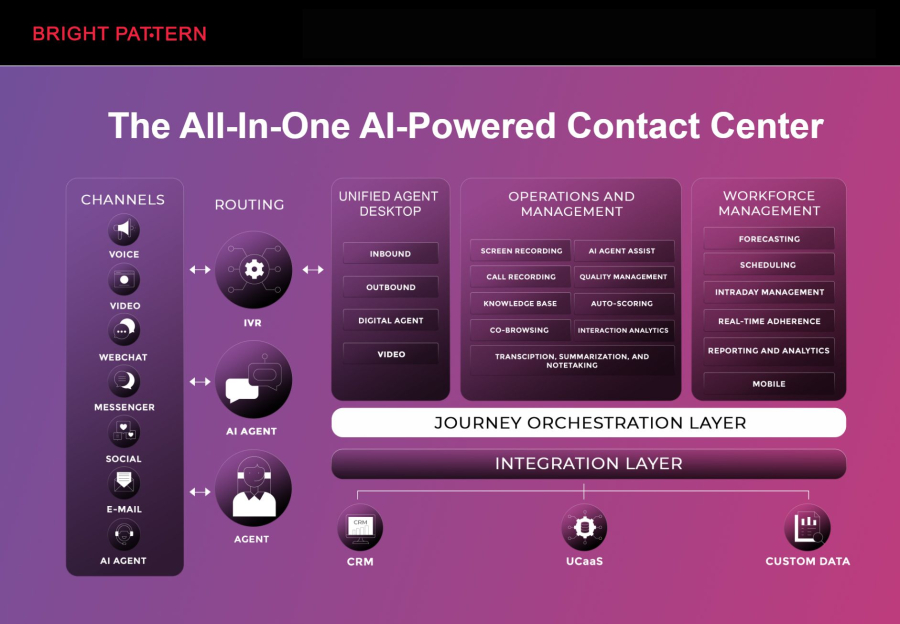
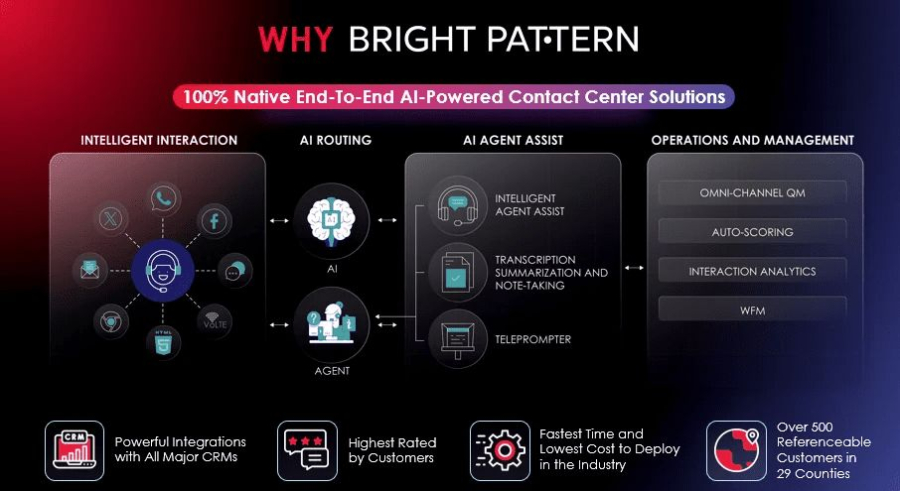
Bright Pattern offers a comprehensive platform for AI-driven contact center solutions that help businesses deliver smarter and faster customer service. Its cloud-based system integrates AI service management with omnichannel support, ensuring seamless interactions across phone, chat, email, and social media.
Key features include:
- AI-powered routing to connect customers with the right agent instantly
- Virtual agent assist to handle routine inquiries efficiently
- Analytics dashboards to monitor performance and optimize operations
- Omnichannel communication for a consistent customer experience
By leveraging Bright Pattern, organizations can reduce wait times, improve customer satisfaction, and empower service teams to focus on higher-value tasks. Its flexibility makes it suitable for businesses of all sizes looking to enhance their AI service management capabilities.
2. Genesys Cloud CX
Genesys Cloud CX offers AI-driven tools for contact center automation, predictive routing, and real-time analytics, helping organizations manage high volumes of interactions efficiently.
3. Five9 Intelligent Cloud Contact Center
Five9 provides a cloud contact center platform with AI-powered agents, automated workflows, and intelligent CRM integrations for improved agent productivity.
4. NICE inContact CXone
NICE inContact CXone delivers AI-enhanced contact center software with features like omnichannel routing, self-service virtual agents, and performance analytics to improve customer engagement.
5. Talkdesk AI Contact Center
Talkdesk combines AI service management with an intuitive interface, offering automated workflows, speech analytics, and virtual assistants to enhance customer experience.
6. RingCentral Contact Center
RingCentral provides an AI-enabled contact center solution with omnichannel communication, predictive engagement, and real-time monitoring tools to streamline service operations.
7. 8x8 Contact Center AI
8x8 uses AI to improve call routing, automate common queries, and provide actionable insights, helping businesses deliver consistent and efficient support.
8. Avaya OneCloud CCaaS
Avaya OneCloud integrates AI into its contact center software, offering intelligent routing, virtual agents, and robust analytics to optimize service management.
9. Cisco Contact Center AI
Cisco leverages AI to provide personalized customer experiences, virtual assistants, and data-driven insights for better service management and operational efficiency.
10. Aspect Via Customer Engagement
Aspect Via combines AI, automation, and analytics to deliver enhanced contact center experiences and improve overall service performance.
What Is AI Service Management?
AI service managementis the use of artificial intelligence, machine learning, and automation to enhance how services are requested, delivered, supported, and improved across the organization.
It builds on established service management frameworks and tools, but adds capabilities such as virtual agents, intelligent routing, predictive analytics, and self-healing automation. The goal is not to replace humans, but to free them from repetitive tasks so they can focus on complex, high-value work.
Typical AI service management solutions interact with users through natural language, learn from every interaction, and continuously optimize workflows based on data.
Why AI Belongs In Modern Service Management
Traditional service desks often struggle with growing demand, limited staff, and rising expectations for instant, consumer-grade experiences. AI helps close that gap by delivering:
- Faster response and resolutionthrough intelligent triage, auto-resolution, and guided workflows.
- 24x7 availabilitywith virtual agents that never sleep and can handle large volumes of routine questions.
- Consistent qualitybecause AI uses the same decision criteria and knowledge every time.
- Lower handling costsas repetitive tickets and requests are automated end to end.
- Better user experiencewith conversational interfaces, personalization, and proactive notifications.
- Richer insightsfrom analyzing all interactions, patterns, and outcomes to guide continuous improvement.
When done well, AI service management turns the service desk from a cost center into a value engine that supports business growth and employee productivity.
Core Capabilities Of AI Service Management
Most AI service management programs draw from a common set of capabilities. You can adopt them step by step, based on your goals and maturity.
1. Conversational virtual agents
Virtual agents(or chatbots) provide a natural language interface for users to ask questions and make requests across channels such as chat, web, or mobile. Modern agents can:
- Understand user intent in everyday language.
- Ask clarifying questions to gather necessary details.
- Surface relevant knowledge articles instantly.
- Trigger automated workflows, such as password resets or access requests.
- Hand off to human agents gracefully when needed, with full context.
Virtual agents dramatically reduce wait times and absorb a large portion of repetitive tickets, while keeping humans available for complex issues.
2. Intelligent routing and triage
AI can automatically classify, prioritize, and route incoming tickets and requests based on their content, impact, and historical patterns. This means:
- Tickets are assigned to the best agent or team from the start.
- High-impact issues are escalated quickly.
- The number of misrouted or bounced tickets drops significantly.
As a result, users see faster resolutions, and agents spend less time reassigning or clarifying basic information.
3. Smarter knowledge management
Effective AI service management depends on strong knowledge assets. AI helps by:
- Analyzing tickets and chats to suggest new knowledge articles.
- Detecting outdated or unused content that should be refreshed or retired.
- Recommending the right article in real time to agents and end users.
This turns your knowledge base into a living, self-improving resource that continually reduces effort for both users and agents.
4. Predictive incident and problem management
By examining historical incidents, changes, and configuration data, AI models can predict where problems are likely to occur and flag early warning signs such as:
- Unusual spikes in specific types of tickets.
- Recurring issues tied to particular apps, devices, or locations.
- Risky change combinations based on past outcomes.
This enables you to shift from reactive firefighting to proactive prevention, reducing downtime and improving service stability.
5. Workflow automation and robotic process automation
AI-powered orchestration and robotic process automation (RPA) can execute common requests automatically, including:
- Password resets and account unlocks.
- Provisioning standard software or hardware.
- Granting or revoking access based on pre-approved policies.
- Updating records across multiple systems after an approved change.
Automation shortens resolution times from days or hours down to minutes, improves accuracy, and frees staff from repetitive manual work.
6. Self-healing and autonomous remediation
In more advanced environments, AI can detect anomalies and trigger self-healing actions automatically, such as:
- Restarting services when performance degrades.
- Scaling resources when usage spikes.
- Rolling back problematic changes when failure patterns appear.
Self-healing capabilities reduce incidents, minimize impact on users, and support always-on digital services.
Business Outcomes You Can Expect
When thoughtfully implemented, AI service management produces tangible, measurable outcomes for both the business and its customers or employees.
Faster resolution times
Virtual agents, automation, and smarter routing typically shorten mean time to resolve by removing wait times, manual handoffs, and rework. Users get answers in minutes instead of hours, and critical incidents are escalated immediately.
Higher customer and employee satisfaction
People value three things from service: speed, clarity, and convenience. AI supports all three by delivering self-service options, clear guidance, and proactive updates. As a result, experience scores and satisfaction ratings often trend upward after AI deployments.
Lower operating costs
By automating high-volume, low-complexity work, AI reduces the cost per ticket and per request. Service organizations can handle more demand with the same or smaller headcount, while reallocating skilled staff toward innovation, process design, and complex problem solving.
Better service quality and compliance
AI follows defined rules and policies consistently, which helps reduce errors and improves compliance with internal and external requirements. Automated workflows also provide clear audit trails, making reviews and reporting easier.
AI Service Management Use Cases Across The Enterprise
AI service management is not limited to IT. Any function that provides services through requests and tickets can benefit.
- IT service desk: Password resets, software requests, incident reporting, device troubleshooting, and change notifications.
- HR services: Onboarding tasks, benefits questions, policy inquiries, leave requests, and employment verifications.
- Facilities and workplace services: Maintenance requests, space bookings, access badges, and safety reporting.
- Customer support: Product questions, order status, returns, warranty claims, and troubleshooting common issues.
- Finance and procurement: Invoice status, purchase approvals, expense policies, and vendor onboarding.
Taking a shared platform approach across departments amplifies the benefits, as you can reuse AI models, knowledge, and workflows while providing a unified experience.
How AI Fits Into Established Service Management Frameworks
AI does not replace service management frameworks such as IT service management best practices. Instead, it enhances them.
- Incident management: AI handles triage, classification, and initial diagnosis, while human agents focus on complex resolution.
- Request fulfillment: Virtual agents capture requests, and automation executes standard changes and approvals.
- Problem management: Analytics highlight recurring issues and probable root causes based on historical data.
- Change enablement: Risk models assess proposed changes and suggest additional controls where needed.
- Knowledge management: AI identifies content gaps and recommends articles to both agents and users.
- Service level management: Predictive insights help prevent breaches and prioritize work that protects commitments.
This alignment makes AI easier to integrate into existing ways of working and helps you build stakeholder confidence by showing how it supports, rather than disrupts, proven practices.
Designing An AI Service Management Strategy
Success with AI service management comes from clear goals and careful design, not from technology alone. A structured approach helps you deliver value quickly while managing risks.
- Define your vision and outcomes
Decide what success looks like. Examples include reducing average handling time, improving satisfaction scores, or increasing self-service adoption. Link these outcomes to business objectives such as productivity or revenue protection. - Map user journeys and pain points
Interview users and agents, review ticket data, and map typical service journeys. Look for bottlenecks, repetitive questions, and high-friction steps that are good candidates for AI and automation. - Assess your data and platforms
Inventory your current service management tools, knowledge base, and data quality. AI models perform best when they have consistent ticket data, well-structured knowledge, and clear process definitions. - Select initial AI capabilities
Choose a focused set of capabilities for your first phase, such as virtual agents for a handful of use cases, automated routing, or knowledge recommendations for agents. - Start small and iterate
Begin with a pilot area and a manageable scope. Measure the impact, gather feedback, refine your models and content, and then expand to more services and departments. - Invest in change management and training
Educate agents, managers, and users on what AI will do, why it is being introduced, and how it helps them. Provide training so staff can work effectively with AI, not around it. - Measure, learn, and optimize
Track outcomes against your original goals. Use those insights to adjust configurations, expand automation, and refine your roadmap.
Data, Governance, And Risk Considerations
AI service management involves sensitive data and important decisions, so strong governance is essential. A responsible approach helps you earn and maintain trust.
- Privacy and security: Ensure that personal and confidential information is protected. Apply role-based access controls and follow your organization's data handling policies.
- Transparency: Let users know when they are interacting with an AI agent and how their data is used. Provide clear ways to reach a human when needed.
- Bias and fairness: Regularly review AI outputs for unintended bias, such as unequal response quality or prioritization. Adjust models and rules as required.
- Human oversight: Keep humans in the loop for sensitive decisions and high-risk changes. Use AI as a decision support tool, not an unchecked authority.
- Auditability: Maintain logs of AI recommendations, actions, and outcomes. This supports compliance, troubleshooting, and continuous improvement.
Practical Tips For AI Service Management Success
Beyond strategy and governance, a few practical habits make a big difference in the day-to-day effectiveness of AI service management.
- Design conversations, not just intents
When building virtual agents, think in terms of natural conversations. Anticipate follow-up questions, clarify ambiguous requests, and guide users step by step. - Write knowledge for humans and machines
Keep articles concise, structured, and focused on specific tasks or questions. Use clear titles, short steps, and common language so both users and AI can understand them easily. - Use human-in-the-loop reviews
Let agents review suggested responses, routing decisions, or automation actions before they are fully automated. This helps train the models and builds confidence. - Create feedback loops
Collect feedback from users and agents on AI responses. Use thumbs up or down ratings, short surveys, or agent comments to identify where tuning is needed. - Align with your brand voice
Configure AI responses to match your organization's tone and style, so users experience a familiar, trustworthy voice across channels. - Celebrate quick wins
Share visible improvements in speed, satisfaction, or workload reduction. This builds momentum and support for expanding AI capabilities.
Metrics That Prove The Value Of AI Service Management
Select a balanced set of metrics that show value for users, the business, and the service organization.
|
Metric |
What It Measures |
Why It Matters |
|
Average resolution time |
Time from ticket creation to closure |
Shows how much faster issues are resolved with AI and automation. |
|
First contact resolution rate |
Percentage of issues solved in the first interaction |
Indicates effectiveness of virtual agents, knowledge, and agent assist. |
|
Self-service adoption |
Share of requests handled without human agents |
Reflects how well AI channels and portals are meeting user needs. |
|
User satisfaction score |
Feedback from customers or employees after interactions |
Measures overall experience quality and acceptance of AI. |
|
Cost per ticket or request |
Average cost to handle each interaction |
Shows efficiency gains and helps justify investment in AI. |
|
Agent productivity |
Tickets handled per agent or time on value-added work |
Reveals how much AI is augmenting human performance. |
Getting Started: A Simple 90-Day Roadmap
To move from idea to impact quickly, many organizations adopt a focused 90-day plan for their first AI service management initiative.
Days 1 to 30: Discover and design
- Clarify target outcomes and success metrics.
- Choose one or two high-volume use cases, such as password resets or policy questions.
- Review existing knowledge articles and update content where needed.
- Design conversation flows and basic automation steps.
Days 31 to 60: Build and integrate
- Configure your AI service management tools and virtual agents.
- Connect to your service management platform, directories, and key systems.
- Set up routing rules, approval workflows, and common automations.
- Test with a small group of agents and users, and refine based on feedback.
Days 61 to 90: Launch, learn, and scale
- Roll out the AI capabilities to a broader audience with clear communication.
- Monitor performance and experience metrics closely, especially in the first weeks.
- Adjust responses, workflows, and thresholds as you learn.
- Document results and plan the next wave of use cases and departments.
The Future Of AI Service Management
The future of service management is intelligent, predictive, and deeply embedded in the way people work. As AI models become more capable, you can expect:
- Even more natural conversations, with virtual agents understanding complex, multi-step requests.
- Richer personalization based on roles, preferences, and context.
- Tighter integration between monitoring, operations, and service desks for seamless self-healing.
- Service teams evolving into experience designers and automation architects.
By starting now and building a thoughtful AI service management capability, you position your organization to deliver faster, smarter, and more delightful service experiences for years to come. The result is a service function that does more than fix problems it becomes a strategic partner in driving digital success.
